

London’s most characteristic season is not winter, and not spring. It is the long interval between them — when the day begins crisp, softens without warning, and returns to cold by early evening. The city doesn’t just change temperature; it changes mood, pace, and light.
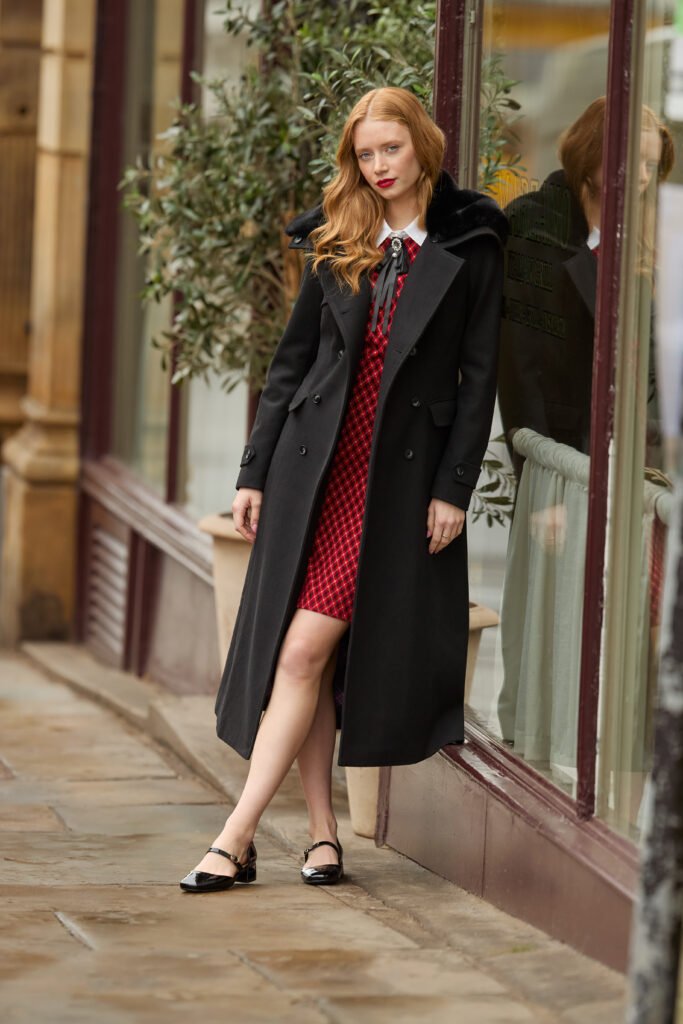
This is why ‘what to wear’ becomes less about trends and more about a system. In-between dressing is a small engineering problem: warmth without heaviness, polish without stiffness, and adaptability without looking as though you dressed for a forecast you don’t believe.
The real problem is not cold — it is contrast
The challenge is rarely the outside alone. It is the constant switching: street to Tube, café to meeting, sunlight to drizzle, heated interiors to sharp air. Clothes that fail in transitional weather fail in one of two ways: they trap warmth until you feel overdone, or they hold none and leave you restless all day.
A reliable in-between outfit does something deceptively difficult: it keeps the body comfortable while letting the face remain “alive”. That is why absolute black, under a pale London sky, can be an aesthetic mistake. It photographs beautifully. It can also drain warmth from the complexion in real daylight — especially when the air is already doing that work.
The most convincing women in this season look as if they did not have to think too hard. They did think — just earlier, when they built the base.
Build a backbone, not a collection
Transitional dressing does not need a large wardrobe. It needs a coherent one. A lightweight trench in structured cotton or a wool blend remains the outer layer London understands: it moves, it holds shape, it reads “finished” even when everything underneath is simple. Under it, a softly tailored blazer gives warmth without the heaviness of a full coat — and it behaves indoors.
Then come the quiet workhorses: a fine-gauge knit that can sit under a jacket without bunching; a long-sleeve base layer in a breathable fabric that does not cling; straight-leg trousers that hold their line; a midi skirt that adds ease and movement when the day warms. Footwear should be chosen for London’s reality, not its fantasy — leather ankle boots for mornings that bite, and a closed-toe flat or low heel for days that become mostly indoors.
The difference is not that these pieces are “special”. It is that they are compatible. A backbone is made of items that talk to each other without argument.
Fabric matters more than silhouette here. Heavy wool becomes punitive by afternoon; rigid shirting fights the body when layers are added. Transitional weather rewards materials that adjust: softer blends, knits with natural give, lightly lined outerwear, cotton that breathes. This is the unglamorous truth: comfort is what allows elegance to hold for twelve hours, not twelve minutes.

Layering is discipline, and discipline is what reads as style
Layering, done well, is almost invisible. It is a sequence, not a pile: a breathable base, one insulating layer, and one protective outer layer. After that, the outfit gains weight more easily than it gains usefulness.
Colour works the same way. Neutral does not mean stark. Charcoal, soft navy, warm grey, chocolate, olive and off-white do something black and pure white often cannot: they adapt to changing light. They look intentional in a bright morning and still make sense by late afternoon. They also allow skin, hair and jewellery to carry the emphasis — a subtle form of “dress” that never feels theatrical.
In-between weather exposes weak wardrobes because it is unforgiving with improvisation. But it rewards thoughtful ones, too. A system removes drama. It leaves room for presence.
And in London, presence is often the most persuasive form of elegance.
Related reading: Quiet Luxury and Neutral Wardrobes: A Strategy That Endures